
Salt-Based Water Softeners vs. Salt-Free Water Conditioners: What Arizona Homeowners Need to Know
If you've been researching ways to deal with hard water in your home, you've probably come across two main options: salt-based water softeners and salt-free water conditioners. They sound similar, they both address hard water, and they're often marketed side by side — but they work in completely different ways and deliver very different results.
Here in the East Valley, where water hardness regularly hits 15+ grains per gallon, choosing the right system matters. This guide breaks down exactly how each one works, what it does (and doesn't do) for your home, and how to know which is the right fit for you.
What Is Hard Water and Why Does It Matter in Arizona?
Hard water contains high levels of dissolved minerals — primarily calcium and magnesium — picked up as groundwater moves through rock and soil. Phoenix Valley tap water is some of the hardest in the country. That mineral load is responsible for the white scale buildup on your faucets, the filmy residue on your dishes, the dry skin and dull hair after a shower, and the sediment quietly destroying your water heater from the inside out.
Left untreated, hard water shortens the lifespan of your appliances, clogs pipes over time, and costs you money in energy bills and premature replacements. A water treatment system is one of the smartest investments an Arizona homeowner can make.
Salt-Based Water Softeners: How They Work
A traditional salt-based water softener uses a process called ion exchange to remove hardness minerals from your water supply before it ever reaches your faucets, appliances, or pipes.
Here's the basic process: water passes through a tank filled with resin beads that carry a sodium charge. Calcium and magnesium ions in the water are attracted to the resin and swap places with sodium ions — leaving the minerals behind and releasing a tiny amount of sodium into the water instead. The result is water that has been genuinely softened — the hardness minerals have been physically removed.
Periodically, the resin tank regenerates using a brine solution (salt and water), flushing the captured minerals out and recharging the resin beads so the cycle can continue.
What Salt-Based Softeners Do Well
Truly eliminate hard water minerals — calcium and magnesium are removed from the water supply entirely
Prevent scale buildup in pipes, fixtures, water heaters, dishwashers, and washing machines
Dramatically extend appliance lifespan, especially water heaters where sediment buildup is a leading cause of failure
Improve the feel of water — skin feels softer, hair feels cleaner, soap lathers more effectively
Protect your plumbing long term by stopping mineral accumulation inside pipes
What to Know Before You Buy
Requires regular salt refills — typically every 4 to 8 weeks depending on household size and water usage
Adds a small amount of sodium to your water (not a concern for most households, but worth noting for those on sodium-restricted diets)
Requires a drain connection for the regeneration cycle
Salt and wastewater discharge are regulated in some Arizona municipalities — check local guidelines before installing
Salt-Free Water Conditioners: How They Work
A salt-free water conditioner — sometimes called a water descaler or template-assisted crystallization (TAC) system — does not remove hardness minerals from your water. Instead, it changes the physical structure of those minerals so they behave differently.
Through a catalytic process, calcium and magnesium are converted into microscopic crystals that no longer bond to surfaces. The minerals are still present in the water — you're still drinking and bathing in hard water technically — but they pass through your plumbing without sticking to pipes, fixtures, or heating elements.
What Salt-Free Conditioners Do Well
Reduce scale formation on pipes and appliances without chemicals or salt
Require virtually no maintenance — no salt to add, no regeneration cycle, no electricity needed
Produce no wastewater — a consideration for water-conscious households and areas with discharge restrictions
Preserve beneficial minerals in drinking water
Compact and low-maintenance — a good fit for homeowners who want a set-it-and-forget-it solution
What to Know Before You Buy
Does not soften water — hardness minerals remain in the water, which means you may still see some spotting on dishes and glass, and water may not feel as silky as fully softened water
Results on scale prevention vary based on water hardness levels and water usage patterns
Existing scale buildup is not reversed — conditioners prevent new buildup but don't remove what's already there
Less effective in extremely hard water conditions without additional filtration support
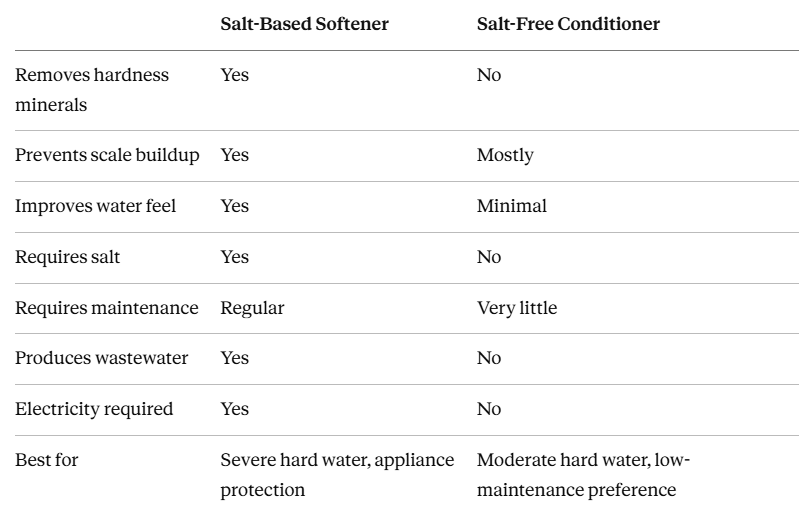
Side-by-Side Comparison
Which One Is Right for Your Arizona Home?
For most East Valley homeowners dealing with the Valley's notoriously hard water, a salt-based water softener delivers the most comprehensive protection — especially if you're concerned about water heater lifespan, pipe health, and the day-to-day experience of your water.
A salt-free conditioner may be a great fit if you're looking for a low-maintenance option, live in an area with discharge restrictions, prefer to keep minerals in your drinking water, or want to pair it with a reverse osmosis system for drinking water quality.
The right answer depends on your water hardness level, household size, plumbing age, and personal priorities — and that's exactly why we recommend starting with a water quality assessment before making any decision.
Let Mountain Vista Plumbing Help You Choose
At Mountain Vista Plumbing, we install and service water treatment systems across Mesa, Gilbert, Chandler, Queen Creek, San Tan Valley, and the entire East Valley. We'll test your water, walk you through your options honestly, and recommend the system that actually fits your home — no upselling, no pressure.
Call us today: (480) 847-9769 Learn more: mountainvistaplumbing.com/water-treatment
Licensed • Bonded • Insured | Honest Upfront Pricing | Serving the East Valley
